



 *Download the article in PDF format *Download the article in PDF format |
 *Watch the YouTube video *Watch the YouTube video |
|---|
*Watch the Rumble Video |
 *Watch the BITCHUTE video *Watch the BITCHUTE video |
|---|
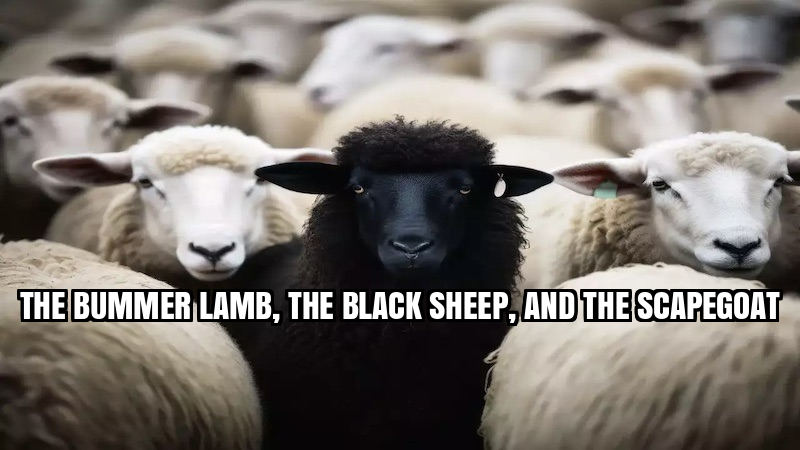
The “bummer lamb black sheep scapegoat” is a combination of metaphors used to describe an individual who is ostracized and blamed by their family for being the cause of the problems in a dysfunctional family unit. While the terms “bummer lamb,” “black sheep,” and “scapegoat” have distinct meanings, they often overlap and are used to characterize the role of a misfit, outcast, or an ostracized person within a dysfunctional family system.
The bummer lamb:
- This term refers to a real-life practice in shepherding. A “bummer lamb” is a newborn rejected by its mother, who will refuse to nurse or care for it.
- The abandoned lamb will die without the shepherd’s intervention. As a result, the “bummer lamb” has a broken spirit and is dependent on the care of an outside party. The term is often used metaphorically in Christian and Messianic stories to represent a person who feels broken and rejected by others. Still, it is saved and cared for by Yeshua (Jesus), the Good Shepherd.
The black sheep:
- The term is derived from nature, where a black sheep is a genetic anomaly born into a flock of white sheep. In early times, the wool of black sheep was considered less valuable because it could not be dyed.
- The term refers to someone who is considered a disgrace or embarrassment to their family or group because they deviate from accepted norms. The “black sheep” may be the target of blame simply for being different in their set-apart faith, hobbies, interests, values, or life choices. Messianic Jews and Hebrew Roots converted believers are often criticized as “black sheep” due to their beliefs, which deviate from the larger Judaism and Christian faiths.
The scapegoat:
- The term is derived from an Old Testament Jewish ritual performed on Yom Kippur, the Day of Atonement. The high priest would symbolically transfer the sins of the community onto one of two goats by laying hands on its head. This “scapegoat” was then released into the wilderness, carrying the people’s sins away with it.
- A scapegoat person is someone who is unfairly blamed and punished for the actions, conflicts, or problems of others. In a family, a scapegoated child is singled out to bear the family’s unhealthy dynamics, allowing other members to avoid accountability for their own issues.In a dysfunctional family, the roles of the “bummer lamb,” “black sheep,” and “scapegoat” often overlap and merge.How the “bummer lamb / black sheep / scapegoat” role affects health:All aborted children are bummer lambs, having been rejected, killed, and discarded by their mother and other abortion procedure participants. Yet, some children are born to mothers who soon afterward reject them, as do other family members.The chronic stress and trauma of being the black sheep and scapegoat can severely harm a person’s long-term health. In a dysfunctional family, the black sheep often takes on the role of the scapegoat for the family’s problems.Potential health impacts include:* Mental health issues: Chronic rejection and shame can lead to severe anxiety,
depression, and low self-esteem.* Complex trauma: The constant emotional abuse and invalidation from family
members can result in post-traumatic stress disorder (C-PTSD).* Physiological effects: The sustained mental distress from rejection can trigger a
chronic stress response in the body, which has been shown to cause elevated
inflammation, a risk factor for many illnesses.* Coping mechanisms: To deal with the emotional pain, many bummer lamb black
sheep scapegoats turn to unhealthy coping mechanisms, such as substance
abuse with alcohol and drugs, sexual immorality, and other forms of self-harm.* Damaged relationships: The bummer lamb, black sheep, scapegoat can find it
difficult to form healthy, trusting relationships outside of the family. This is
often due to being raised in a toxic family environment, thus having to learn
normal social interaction skills. Without having learned these skills in a good
family environment, this can lead to awkwardness, isolation, and loneliness in
seeking to develop relationships outside of the family home.How to overcome the bummer lamb, black sheep, scapegoat trap?
Breaking free from this role and minimizing its negative health effects is possible through a process of awareness, boundary-setting, and self-healing.
* Reframe your identity: Recognize that the bummer lamb, black sheep,
scapegoat stigmatization role that your family gave you is a product of your
family’s dysfunction and is not a reflection of your self-worth.* Set boundaries: Limit contact or go no contact with toxic family members to
protect your emotional, mental, and physical well-being.* Build a chosen family: Seek out friends, partners, or communities that offer you
acceptance, respect, and support.* Seek therapy: A therapist can help you process the trauma, discover your self-
worth, and develop healthier coping strategies. This does not necessarily mean
seeing a psychiatrist in person. There are many self-help videos on YouTube and
other social media websites that offer great, helpful advice for free.* Seek Yeshua (Jesus), the Good Shepard.
MATTHEW 11:28 (NKJV):
“Come to Me, all you who labor and are heavy laden, and I will give you rest.”JOHN 10:11-28 (NKJV-Condensed):
“I am the Good Shepherd. The Good Shepherd gives His life for the sheep. I am the Good Shepherd; and I know My sheep, and am known by My own. As the Father knows Me, even so I know the Father; and I lay down My life for the sheep. My sheep hear My voice, and I know them, and they follow Me. And I give them eternal life, and they shall never perish; neither shall anyone snatch them out of My hand.”

